
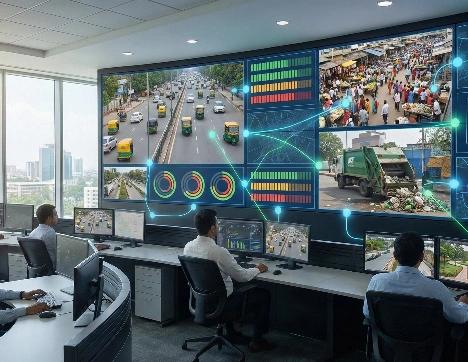
India Doesn’t Have a CCTV Problem. It Has an Intelligence Problem.
India is rapidly becoming one of the world’s largest surveillance markets. But while cameras are scaling fast, intelligence systems aren’t evolving at the same pace. Most CCTV deployments today still focus on recording footage — not understanding it. And that gap changes everything.
India is rapidly becoming one of the world’s largest surveillance markets.
Cameras are being installed across cities, highways, buses, factories, borders, offices, and public spaces on a massive scale. Governments are investing billions into “smart surveillance.” AI-powered monitoring is no longer experimental — it’s already operational.
On paper, it sounds like progress.
But the headlines tell a different story.
In the UK, AI-powered CCTV systems scanned 1.7 million faces this year alone. Alongside this expansion came reports of innocent people being flagged, wrongful identifications, and watchlists being misused.
In India, the same pattern is emerging in a different form:
CCTV systems going offline
Violations going undetected
Massive footage being generated with little active analysis
Surveillance becoming reactive instead of intelligent
The issue isn’t that India lacks cameras.
The issue is that most surveillance systems stop at recording.
We Are Building Surveillance Infrastructure at Massive Scale
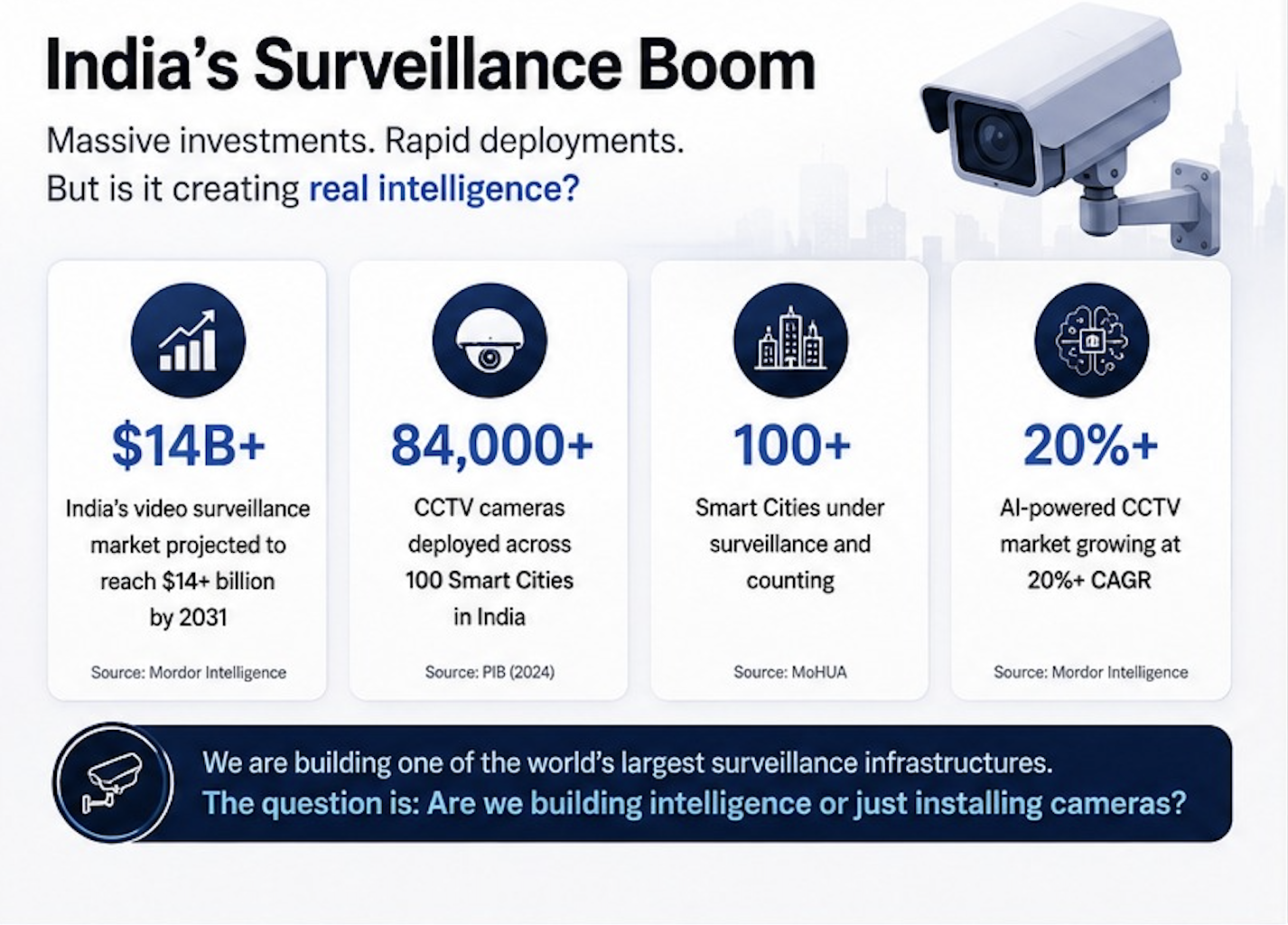
India’s video surveillance market is projected to cross $14 billion by 2031. More than 84,000 CCTV cameras have already been deployed across India’s 100 Smart Cities.
On the surface, this suggests visibility is improving rapidly.
But visibility alone is not intelligence.
Today, most CCTV deployments operate on a very simple assumption:
Install enough cameras, and safety will improve automatically.
But cameras don’t solve problems.
They collect data.
What happens after that is what actually matters.
Most CCTV Systems Today Are Built Like Archives, Not Assistants
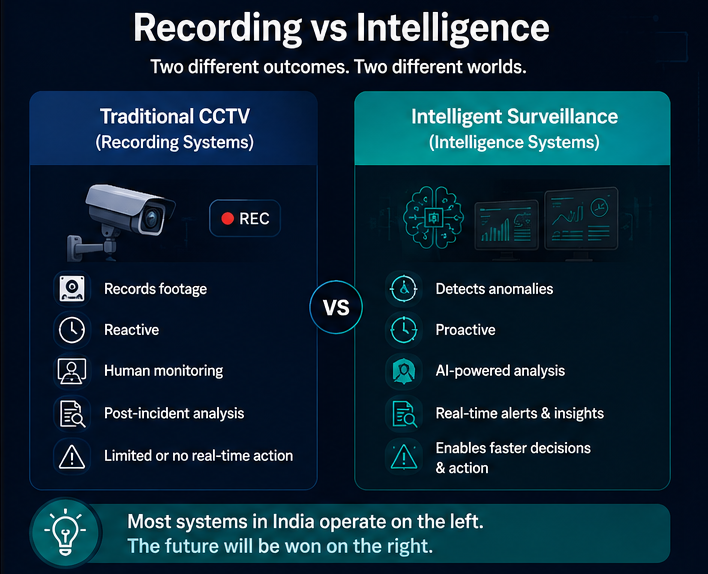
Traditional surveillance systems are fundamentally passive.
They:
record footage
store footage
retrieve footage after an incident
That model worked when CCTV was primarily a forensic tool.
But modern surveillance environments are no longer dealing with isolated incidents. They are dealing with:
massive scale
real-time movement
operational complexity
human limitations in monitoring
A control room operator cannot actively process hundreds of live feeds simultaneously for hours.
Which means most footage is never meaningfully interpreted.
The result?
Surveillance becomes documentation instead of decision-making.
The gap between a recording system and an intelligence system is enormous.
A recording system tells you what happened.
An intelligence system helps you understand:
What is happening?
What matters?
What requires action?
What could go wrong next?
That difference changes everything.
The Real Problem Isn’t Visibility. It’s What Happens After Visibility.
Three headlines from the same week in April 2026 reveal the problem clearly.
Panchkula
CCTV systems across the city went offline. Traffic challans dropped drastically because enforcement systems depended entirely on functional surveillance infrastructure.
Punjab Border
Over 2,200 cameras were deployed across border locations as a “second line of defence.”
But deployment alone doesn’t create actionable intelligence. Someone still has to interpret patterns, prioritize threats, and trigger responses.
Adilabad
Public buses were fitted with CCTV systems for women’s safety.
The expectation? Cameras would create deterrence.
But deterrence without active monitoring or intervention often becomes symbolic infrastructure rather than operational protection.
Different deployments.
Different objectives.
Same underlying logic:
Install cameras. Hope that’s enough.
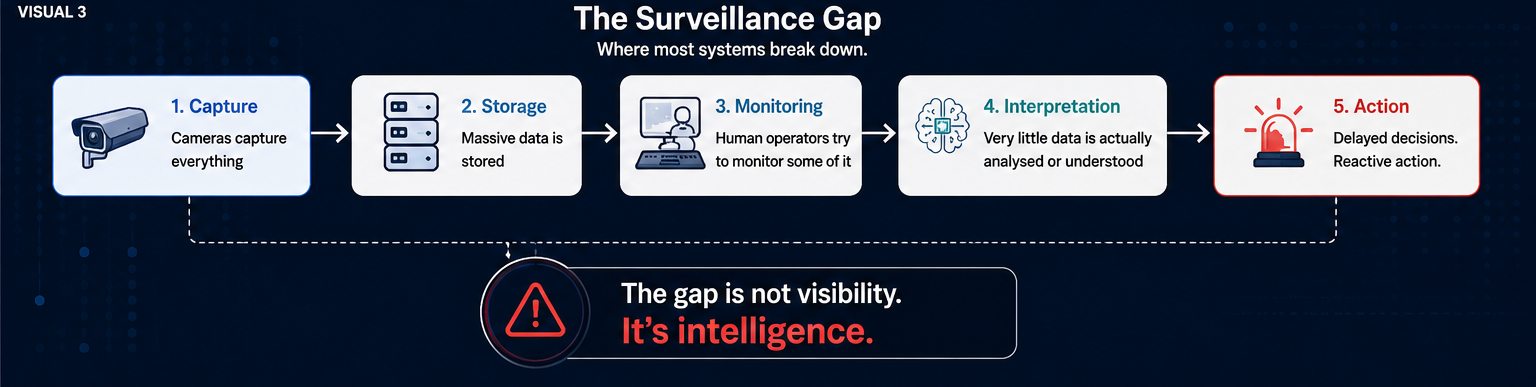
This is where most surveillance systems break down.
Not captured.
At interpretation.
What Intelligent Surveillance Actually Looks Like
The future of surveillance is not about replacing humans with AI.
It’s about building systems that help humans focus on what actually matters.
Because the biggest challenge today is not lack of footage.
It’s information overload.
Modern surveillance systems generate enormous amounts of visual data every second. No human team can realistically monitor all of it effectively in real time.
That’s where intelligence layers become important.
1. Real-Time Prioritization
Most systems today treat all footage equally.
Intelligent systems don’t.
They identify:
unusual movement
restricted zone access
abnormal crowd formation
suspicious patterns
operational stoppages
unattended objects
Instead of forcing operators to watch everything continuously, intelligent systems surface what deserves attention first.
The goal isn’t to watch more footage.
It’s to know what actually matters.
2. Contextual Alerts Instead of Passive Recording
Traditional CCTV systems are mostly reactive.
They help answer:
“What happened?”
Modern intelligence systems aim to answer:
“What is happening right now?”
That shift completely changes the value of surveillance.
Instead of simply storing footage, systems can trigger contextual alerts for:
unauthorized access
unsafe behavior
prolonged machine idle time
suspicious movement patterns
crowding in sensitive zones
workflow disruptions
This transforms surveillance from passive observation into operational support.
3. Human + AI Collaboration
The strongest surveillance systems are not fully autonomous.
And they shouldn’t be.
AI systems still have limitations:
bias
false positives
contextual misunderstanding
edge-case failures
Which is why the future is not “AI replacing humans.”
It’s AI reducing human overload.
Strong systems combine:
automated detection
human verification
contextual decision-making
operational workflows
The objective is not to remove humans from the loop.
It’s to help them make faster, better-informed decisions.
4. Surveillance Is Becoming Operational Intelligence
The biggest shift happening right now is that cameras are no longer being used only for security.
They are increasingly becoming operational tools.
In industrial and enterprise environments, intelligent monitoring systems can help identify:
bottlenecks
workflow inefficiencies
unsafe behavior
compliance violations
machine downtime
process anomalies
The same infrastructure that once existed only for recording incidents is now evolving into a layer for operational visibility.
That changes how organisations make decisions.
And it changes what surveillance systems are expected to do.
The Future Isn’t More Surveillance. It’s a Better Interpretation.
India’s surveillance conversation is currently focused on deployment.
How many cameras?
How much coverage?
How much investment?
But the more important question is still missing:
What exactly are these systems understanding?
Because cameras alone do not create intelligence.
Systems do.
The next generation of CCTV systems won’t just record incidents.
They’ll help organisations:
understand patterns
prioritize action
reduce response time
improve operational visibility
support real-time decision-making
That shift from passive surveillance to operational intelligence is where the real transformation begins.