
The Missing Layer in Jensen Huang's AI Stack
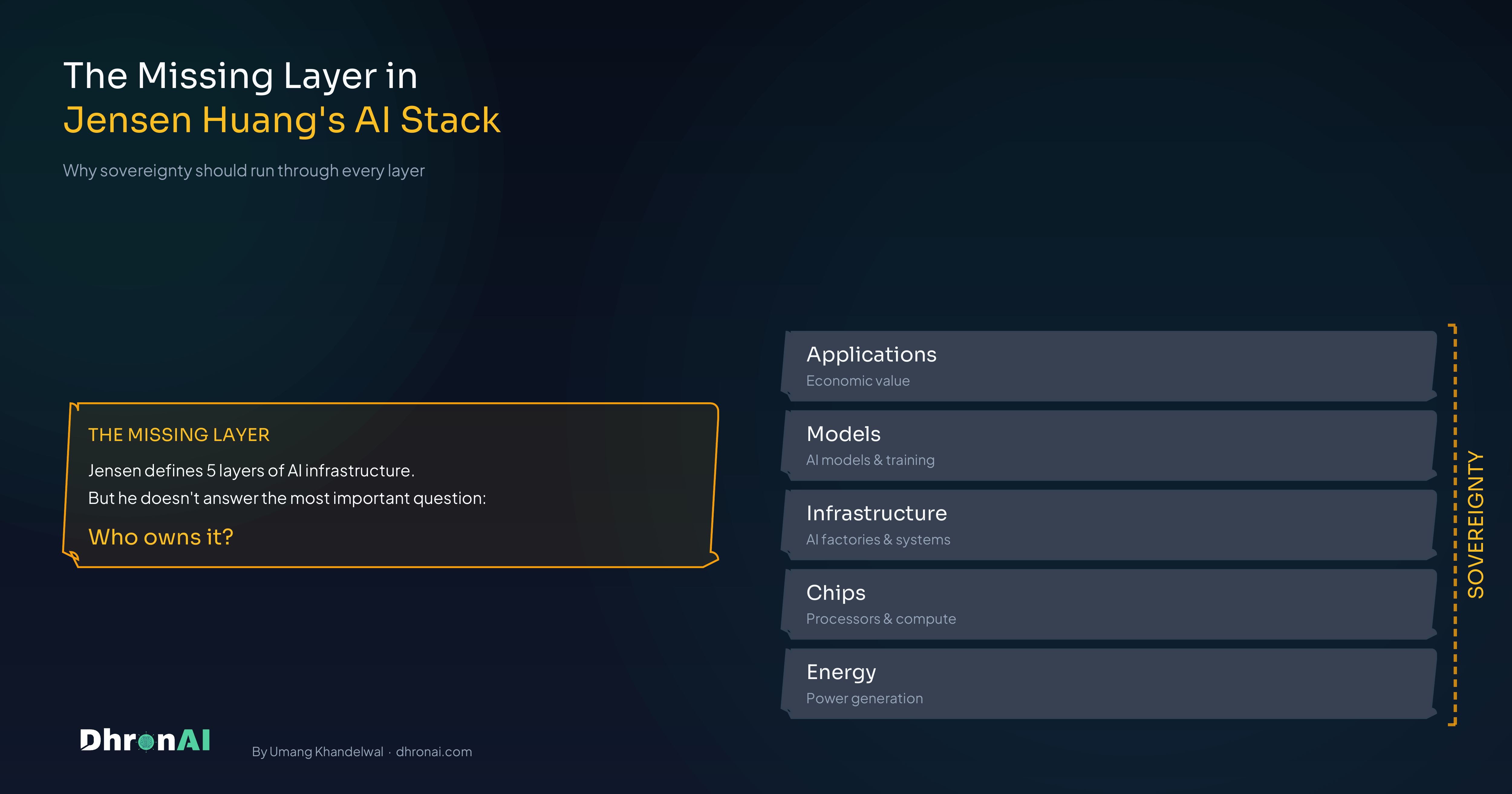
Jensen Huang defines AI as a 5-layer stack: Energy → Chips → Infrastructure → Models → Applications. He's right, but misses one critical layer: Sovereignty. Most enterprises control only the application layer. Everything underneath? Someone else's cloud, someone else's jurisdiction. That's not AI adoption, it's dependency. This blog explores the missing layer and how DhronAI gives enterprises the power to own their AI stack, not rent it.
Jensen Huang recently published one of the most important frameworks for understanding AI in 2026. His thesis is simple and powerful: AI is not a clever app or a single model. It is essential infrastructure like electricity and the internet.
He lays it out as a five-layer stack:
Energy → Chips → Infrastructure → Models → Applications.
Every successful application pulls on every layer beneath it, all the way down to the power plant that keeps it alive. He calls this the largest infrastructure buildout in human history, with trillions of dollars yet to be invested.
He's right. And we agree with nearly every word.
But there's a layer missing from his framework. One that matters more to enterprises, governments, and nations than any of the other five.
Sovereignty.
The Question Jensen's Framework Doesn't Answer
Jensen says every company will use AI. Every country will build it.
We agree. But there's a difference between using AI and owning AI, and that difference is where the next decade of enterprise competition will be decided.
Consider the five layers through the lens of a bank, a law firm, or a government department:
Energy, they don't control this. They buy it from a utility.
Chips, they don't control this either. They buy hardware or rent compute.
Most enterprises rent infrastructure from cloud providers. Their AI runs on someone else's servers, in someone else's data centres, often in someone else's jurisdiction.
Models most enterprises use third-party models via API calls. They don't own the weights. They don't control the training data. They can't audit what the model knows or doesn't know.
Applications, this is typically the only layer enterprises control. And even here, the application sits on top of four layers that they have zero ownership over.
So when Jensen says AI is essential infrastructure, the natural follow-up question for any enterprise leader is: whose infrastructure?
If the answer is "someone else's" for four out of five layers, that's not AI adoption. That's AI dependency.
Why Sovereignty Is the Missing Layer
Sovereignty isn't a sixth layer that sits on top of Jensen's five. It's a property that should run through all of them, a principle that determines whether an organization truly owns its AI capability or merely rents access to it.
For industries where data sensitivity, regulatory compliance, and operational control are non-negotiable, banking, legal, healthcare, government, and defence, sovereignty isn't a nice-to-have. It's the prerequisite for AI adoption at all.
Think about what happens without it:
Compliance risk. When your AI processes sensitive data on infrastructure you don't control, you're trusting someone else's security, someone else's jurisdiction, and someone else's interpretation of data protection law.
Operational fragility. When your AI stack depends on 8-12 different vendors, a pricing change, an API deprecation, or a service outage at any layer can break your entire system. You've built critical capability on borrowed ground.
Strategic dependency. When you don't own your models or your training pipeline, you can't differentiate. Every competitor using the same API gets the same intelligence. Your institutional knowledge, the 20 years of decisions, case files, and domain expertise that make your organization irreplaceable, never becomes a competitive advantage because it never gets encoded into a system you own.
Sovereignty means owning the layers that matter. Not all five are practical or necessary for most enterprises. But the layers where your data lives, your models train, and your intelligence deploys? Those need to be yours.
What Sovereign AI Infrastructure Actually Looks Like
This is the problem we set out to solve at DhronAI.
Our platform, AI-INICIO, is built on a simple premise: enterprises should be able to build, own, and operate their AI systems entirely within their own infrastructure. No data is leaving their jurisdiction. No vendor lock-in. No black-box models they can't control.
AI-INICIO has three integrated components:
AI Foundry is a structured 7-module pipeline that takes raw enterprise data scattered across PDFs, emails, legacy systems, and databases and transforms it into a deployed, fine-tuned AI model. Every step runs on-premise: data scraping, parsing, chunking, dataset generation, validation, fine-tuning, and deployment.
AI Studio is a cognitive digital twin platform that maps every business entity, relationship, and operational flow in your enterprise. It gives AI agents a structured environment to operate within, preventing hallucinated workflows and ensuring automation aligns with real business logic.
Dhron is the central intelligence layer, a self-healing, self-expanding system that monitors the entire platform, traces root causes when something breaks, and evolves the system as requirements change.
Together, these three components give enterprises sovereignty over the layers that matter most in Jensen's stack: infrastructure, models, and applications.
We can't give you sovereignty over energy or chips. But we can ensure that from the moment your data enters the pipeline to the moment your AI model serves its first response, everything stays within your walls.
Jensen Is Right. The Buildout Is Massive. The Question Is Who Owns It.
Jensen describes AI factory facilities designed not to store information but to manufacture intelligence. He's right that these are being built at an unprecedented scale.
But not every organization needs an AI factory the size of a data centre. What they need is an AI factory they can own. One that sits within their compliance boundary, runs on their hardware, and produces intelligence from their institutional knowledge.
That's what AI-INICIO is. A sovereign AI factory for the enterprise.
Jensen says the choices we make now, how fast we build, how broadly we participate, and how responsibly we deploy will shape what this era becomes.
We'd add one more: how much of it we own.
Because the enterprises that thrive in the AI era won't just be the ones that adopted fastest. They'll be the ones that owned what they built.
DhronAI builds sovereign AI infrastructure for enterprises in BFSI, legal, healthcare, and government. Learn more at dhronai.com and explore AI-INICIO at aiinicio.com.