
What Automation Actually Unlocks for a Business
Automation isn't just about working faster — across manufacturing, finance, and healthcare, the data shows it fundamentally changes what a business can do, decide, and scale. But the gap between automation that transforms and automation that disappoints comes down to one thing: whether it was built around your workflow, or someone else's.
Automation has become one of the most overused words in business. Every software vendor promises it. Every consultant recommends it. And yet, most conversations about automation stop at the surface — faster processes, less manual work, cost savings.
The real story is more significant than that. Automation doesn't just speed up what already exists. It fundamentally changes what a business is capable of. New decisions become possible. New revenue becomes reachable. Entire categories of operational risk quietly disappear.
Here's what it actually looks like — industry by industry, backed by data.
30% higher average growth rate recorded by businesses that chose to automate versus those that relied on manual processes (North American Industry Report). That gap compounds every year automation is in place.
01 | Manufacturing From Reactive Operations to Predictive Control
Manufacturing has historically been the industry most transformed by automation — and the data from the last two years makes clear the gap between automated and non-automated operations is widening, not closing.
The shift isn't just about robots on a production line. It's about what happens when machines, data, and decisions are connected in real time. Predictive maintenance alone — where AI flags equipment issues before failure — is eliminating unplanned downtime that previously cost manufacturers millions in lost production hours.
The Numbers:
600,000 robotic units projected installed globally in 2024, up from prior years
$97B global smart factory software market projected to exceed by 2028
30% higher growth rate for businesses that automate vs. those that don't
Real Example — Siemens Siemens deployed digital twin technology across automotive assembly lines — creating virtual replicas of physical production systems that could be tested, optimised, and reconfigured without ever stopping the real line. The result: reduced downtime, improved efficiency, and the ability to simulate changes before committing to them. The competitive advantage isn't the technology itself — it's the decision-making speed it enables.

What separates leaders from laggards in manufacturing today isn't access to automation — it's how deeply it's integrated into the operational workflow. Off-the-shelf automation handles standard processes. The real edge comes when automation is built around the specific way a factory actually runs.
02 | Finance The End of Reactive Decision-Making
Finance teams spend an extraordinary proportion of their time on work that generates zero strategic value — reconciliations, approvals, data entry, reporting cycles. Automation doesn't just speed this up. It eliminates the category of work entirely.
The downstream effect is what matters most. When finance teams are freed from manual processing, the entire character of the function changes — from backward-looking scorekeepers to forward-looking strategic partners. Decisions that previously required a week of data gathering happen in real time.
The Numbers:
26% increase in approved loans at CashCo Financial after automating loan origination workflows
5× faster launch than building in-house, reported by CashCo after workflow automation
50% reduction in insurance claims processing times through automation
Real Example — CashCo Financial CashCo Financial, a Canadian alternative lending provider, had separate in-person and online loan application processes that couldn't talk to each other. Approvals were slow. Staff inefficiency was high. After automating and unifying their loan origination workflow, they recorded a 26% increase in approved loans and launched the system 5x faster than a custom in-house build would have taken. The bottleneck wasn't their team — it was the workflow they were forced to work inside.

Automation in finance isn't a cost-cutting exercise — it's a precision tool for unlocking the full capacity of the team you already have.
03 | Healthcare When Administrative Burden Becomes a Patient Risk
Healthcare carries a weight no other industry does: operational inefficiency here doesn't just cost money — it costs time that affects patient outcomes. The administrative burden in healthcare has reached a scale that is no longer manageable through headcount alone.
Administrative costs now account for 40% of total hospital expenses for care delivery. That's not a staffing problem. That's a systems problem — and automation is the only credible answer at that scale.
The Numbers:
$18B in annual savings projected from fully automating high-volume administrative transactions (CAQH 2024)
81% of healthcare finance professionals identified payment automation as a top priority (U.S. Bank, 2024)
68% of payers still reimburse providers using paper checks — up from 60% in 2023
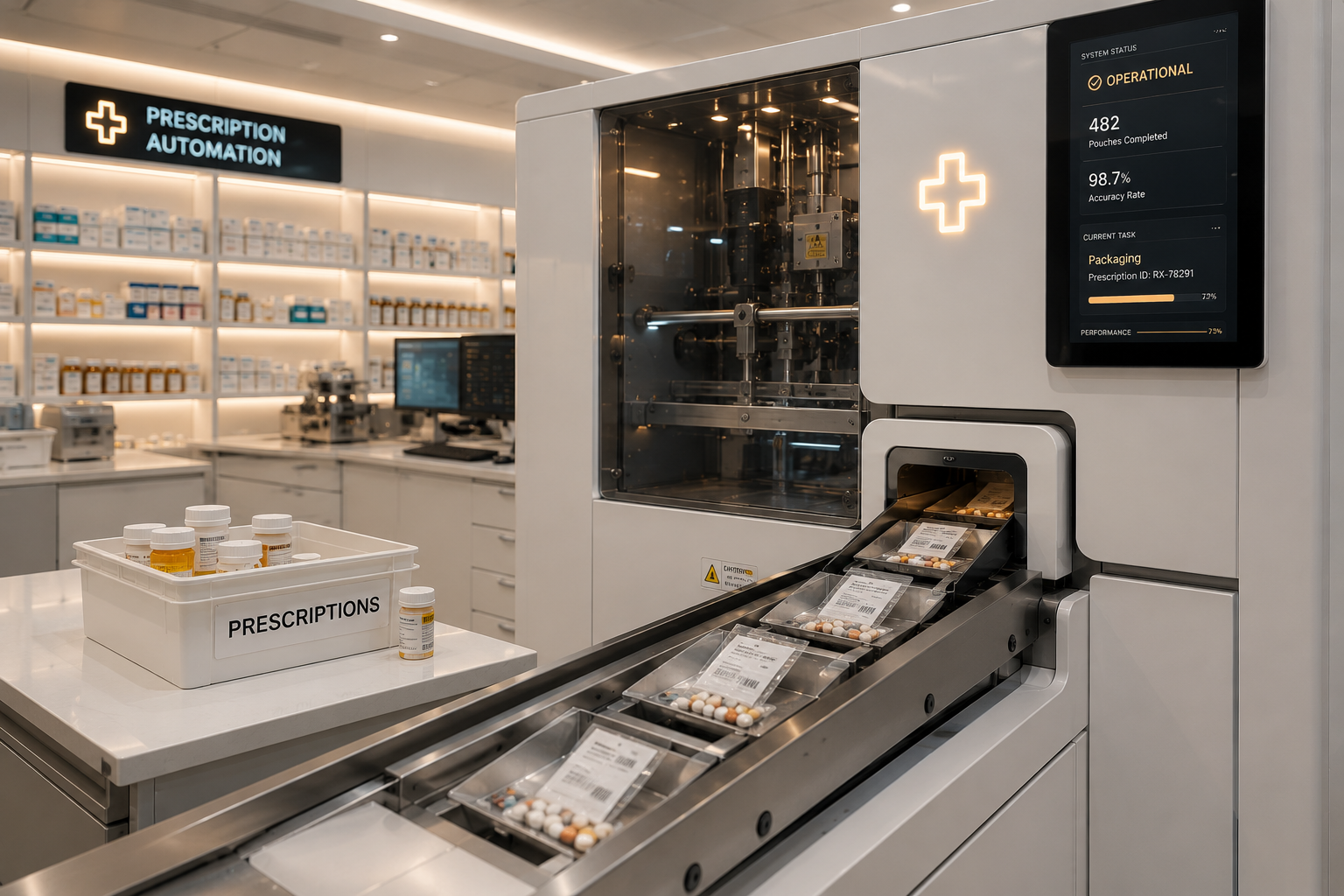
Real Example — Capsa Healthcare In March 2024, Capsa Healthcare launched NexPak — an automated prescription packaging system designed to eliminate medication errors at the point of dispensing. The system automates patient prescription packaging with significantly higher accuracy and efficiency than manual dispensing. In a sector where medication errors are among the leading causes of preventable patient harm, this is automation functioning not as a productivity tool but as a patient safety mechanism.
The healthcare automation market was valued at $43.29 billion in 2024 and is projected to reach $117.5 billion by 2035 — a compound annual growth rate of 9.5%. The question is no longer if automation is necessary. It's how fast it can be deployed.
What Automation Actually Delivers
Across manufacturing, finance, and healthcare, the outcomes of automation follow a consistent pattern. Understanding that pattern is what separates businesses that automate strategically from those that automate reactively.
Decisions that took days now happen in real time
Error rates drop to near zero in automated workflows
Teams shift from execution work to strategic work
Operational capacity scales without proportional headcount
Hidden bottlenecks become visible in the data for the first time
Competitive advantages that were process-dependent become durable
But here's what the data also shows: automation that isn't built around the specific workflow it's meant to serve underdelivers consistently. The $18 billion in healthcare savings CAQH projects assumes full, properly integrated automation — not a patchwork of tools bolted onto a manual process.

The difference between automation that transforms and automation that disappoints almost always comes down to one thing: whether the system was built to fit the operation, or whether the operation was bent to fit the system.
Ready to build automation that actually fits?
The data is clear. The outcomes are proven. The only variable is whether the automation is built around your workflow — or someone else's.